Reading time: 10 minutes
Jessica Desamero, PhD
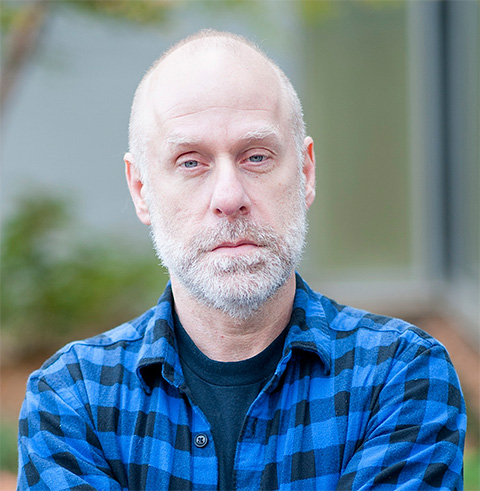
Today, Roland Dunbrack is a renowned, out and proud computational structural biologist. At Fox Chase Cancer Center, he builds and analyzes structural models to develop insights that will lead to better design of cancer therapies. As a queer advocate, he is outspoken about LGBTQIA+ issues on social media and with those around him. But, like many queer scientists, his road to self-acceptance was a long one.
First realizations of being gay and loving science
Dunbrack knew he was gay at 9 ½ years old. But since he was raised in Massachusetts as a Catholic, where queerness was considered bad or wrong, as a teenager he had to hide his sexuality.
Shortly after he graduated from high school in 1981, the Centers for Disease Control and Prevention (CDC) officially recognized the AIDS epidemic. This fed into his fear of being queer. Not much was known about the HIV virus yet. And since the first medically documented cases in the U.S. were exclusively among young gay men, the CDC mischaracterized AIDS as a gay-related disease. Because of this misinformation and subsequent public paranoia, it seemed dangerous to be gay. Thus, Dunbrack remained rigidly in the closet throughout his undergraduate years at Harvard University.
Although he was still closeted throughout college, he couldn’t hide his love of science. He was especially amazed when his freshman chemistry professor Martin Karplus presented a computer simulation on how a protein moved. “It inspired me that you could go from basic mathematics and physics to chemistry, all the way to biology,” he said. “It was very exciting for a freshman.”
The internal struggle of coming out
Dunbrack desired to come out after college, but he felt he needed to be far away from his parents to do so. Thus, he moved to the UK to do a fellowship at the University of Cambridge. From there, he finally started the process of coming out.
This process wasn’t easy for him, and it wasn’t until after he joined queer student groups that he realized just how afraid he was. During his first year at Cambridge, a large part of him still didn’t want anyone to know he was gay. He was still scared of the AIDS epidemic. For a long time, he even wished he wasn’t gay. And despite studying theoretical chemistry, which he truly loved, he couldn’t help but feel increasingly depressed.
“By the spring of that year I was pretty nonfunctional as a scientist,” he said. “I would walk around the roof of the chemistry department thinking, ‘Well this is a place I could jump off of.’ And my parents were very flustered. They had no idea what was going on because I wasn’t communicating.”
Slowly learning self-acceptance with the help of others
What saved Dunbrack’s life was meeting Julia, a fellow graduate student who regularly wore a button with a pink triangle, a symbol of gay and lesbian defiance and pride at the time. Upon meeting her, he expressed that he admired how she proudly wore this button and wished he had the guts to do the same. They then shared experiences about being closeted, mentally struggling to deal with it, and feeling the need to do something before things go badly wrong. Julia soon invited him to a college garden party where he could comfortably wear the pink triangle, and he accepted the invite.
At the garden party, he felt so liberated. He came out to many people and was happy that everyone took his news casually. From there, he slowly started to feel that being gay was not as big a deal as he thought. But at this point, he was still hesitant to let his other close friends know.
His closest friend, now Professor Hugh Hunt of the University of Cambridge, was an Australian man that lived in the college house right next to Dunbrack. Shortly after the garden party, he told Hunt how he came out at this party, as he felt he was going to find out sooner rather than later. Hunt’s response took Dunbrack by surprise.
Hunt said he just thought Dunbrack was depressed because he was uncomfortable living in England as a non-English person, like him. And after Dunbrack said that he would hide in his room after the big reveal, Hunt didn’t accept that answer and strongly insisted he meet him at the college bar. Little did Hunt know this little gesture really moved him.
“It was one of the kindest things anybody’s ever done for me,” he said. “He seemed to realize intuitively that I was embarrassed and ashamed, and that I shouldn’t be.” From there, he gradually realized that being gay was perfectly okay.
After this, Dunbrack took more of Julia’s advice on getting himself back together and back into science. He stayed another year and focused on his biochemistry work. Julia and Dunbrack also started a group on campus called The Cambridge Lesbian and Gay Graduate Student Society. Later, he joined a town group of gay scientists called the Cambridge Gay Group. Interacting with them helped Dunbrack tremendously, especially as he had not previously encountered any out and proud gay scientist up until then. With his new friends, he started going to marches, including one that involved protesting anti-gay policies in front of the houses of Parliament.
Dunbrack finally embraced his gay self, and he couldn’t be happier for it.
Graduate school: a time of computational structural biology and queer advocacy
Now that Dunbrack no longer felt ashamed about being gay, he no longer felt the need to be far away from his parents. After telling his PhD mentor Karplus that he was finally ready for graduate school, he came back to Massachusetts and started his doctoral program at Harvard University.
At Harvard, he encountered Don Wiley, head of the biophysics department. At that time, Wiley just published a paper on the structure of a cell surface protein expressed in all human cells, called human class 1 histocompatibility antigen, or HLA-A2. By analyzing the structure, his team figured out why the protein is so vital for the immune system; it binds to short peptides inside the cell that are markers of infection and presents these peptides on the cell surface. In this way, the immune system can recognize infected cells.
Wiley asked computational folks like Dunbrack to predict the structures of other HLA-A genes and HLA proteins. Dunbrack found that only 10-20 amino acids differed between gene variants, so he thought more deeply about how to model the protein’s side chains.
At the same time, he was part of a project involving the amino acid proline. By fitting molecular dynamics parameters for proline and testing other Protein Data Bank structures, he discovered that the backbone conformation controls the positioning of its side chains.
“It turned out there was a very clear pattern to it, that as you changed each of the backbone dihedrals (the specific twists or torsions of the main polypeptide chain), there are three different rotamers (different 3D orientations of the same molecule that arise from torsion angles),” he said. Dunbrack went on to build the first backbone-dependent rotamer library, a reference that predicts likely side-chain positions based on backbone geometry.
Dunbrack brought his scientific expertise into his queer advocacy. As a Gay and Lesbian Issues Tutor and Biochemistry Tutor (akin to a resident advisor) in a Harvard undergraduate dorm, he helped students deal with their sexuality through sharing stories of his own. He also wrote for the Gay Community News newsletter debunking scientific misconceptions about AIDS. And as part of the Boston AIDS Action Committee, he trained volunteers and gave 3-hour lectures on the basic science behind AIDS and the HIV virus. “I tried to use the science I knew to help my community,” he said.
Lastly, because the AIDS epidemic was still prominent, he conducted additional research related to immunology. “I was thinking, ‘Okay, as a scientist, how can I contribute to fighting HIV?’ So, some of the topics that I chose to work on early in my career was because I was out, because I was gay, and because AIDS and HIV were such a threat to my community. I scientifically wanted to do what I could do,” he said.
After obtaining his PhD at Harvard and completing postdoctoral studies in San Francisco, he moved to Philadelphia and started working at the Fox Chase Cancer Center. He has been there ever since.
Now a renowned computational biologist and proud queer advocate
At Fox Chase Cancer Center, Dunbrack leads a molecular modeling facility, where he uses protein structure prediction to help biology. His team builds structural models that help researchers visualize how proteins function and how they can be targeted in disease. They do a lot of work on kinases, which are enzymes that act like biological on/off switches for molecules in the body and are the targets of many cancer drugs.
Recently, his team has used AlphaFold to model all 437 catalytically active kinase domains in the human genome. “AlphaFold allows you to use a template, a known experimental structure, to help you model the structure of another protein,” he said. “We identified what makes kinases active. And then we use those templates to model all 437.” Dunbrack’s team has modeled kinases in their active form and aims to model them in their inactive form. This work could reveal how kinases shift between active and inactive states and can help guide cancer therapy development. Dunbrack’s team also modeled the conformations of antibodies and of three genes often mutated in cancer, using very similar methods.
Dunbrack is grateful that his research group is supportive of his queerness. “They’ve always been super accepting,” he said. Dunbrack sings in an LGBTQIA+ chorus called Philadelphia voices of Pride, and four people from his lab group attended one of his concerts. Someone even nominated him for a Temple University School of Medicine award recognizing queer advocacy efforts, which he didn’t know about until he won the award.
Dunbrack never fails to share his story to help others. For instance, he shared a glimpse of his story on a queer visibility campaign called 500 Queer Scientists. He also has a rainbow flag on his Twitter and Bluesky profiles, and he posts a lot on LGBTQIA+ issues. (fun fact: he even has a rainbow flag on his LinkedIn profile!)
“(I want) to make sure that especially young queer people know that there are experienced scientists who’ve accomplished a few things, who have been around a long time, that many of us are out in our jobs…And we still have our careers; we’re still successful and respected by the scientific community,” Dunbrack said.
This visibility has had an impact on many. “I’ve had a number of students write to me from a variety of countries like Iran and Ukraine saying how it’s important to them that I’m out, it’s really helpful,” he recounted. And at his recent talk at Drexel University, the queer graduate student that invited him expressed a similar sentiment and introduced him to her future wife.
Dunbrack had gone from hiding and being ashamed about his sexuality to following his scientific dreams and happily advocating for his queer community. He continues to be an inspiration to young queer scientists aspiring to do the same.
Sources for this profile include Dr. Dunbrack himself, as well as the YouTube video of the talk he gave for the International Society for Computational Biology (ISCB), titled “From Pink Triangles to Rainbow Flags: 35 years in Structural Bioinformatics – Roland Dunbrack – LGBTQ+ Symposium 2024”.
For more on Dunbrack’s scientific research journey, please look at the profile story I wrote for ASBMB’s member magazine, ASBMB Today, found here.
The headshot was provided by the interviewee.


Leave a Reply